So, we have now been through many parts of Costa Rica in terms of its regions, people and various climates. First thing to realize is that the distances are actually short, even though driving times are relatively long. If you look at a map, for example, it is about 100Km as the crow flies from San José to Limón. By road it is 160km, and the drive took more than 4 hours on the bus…true we made a few stops, but still. Short distances, but not trivial travel times.
you couldn’t create a forest fire with a gasoline tanker!
As for climate…DRASTIC differences in small distances. I’d call it MAJOR Microclimates…not a contradiction at all! We started in San José , which is in the Central Valley. The climate there is moderate-to-warm year around. It does rain pretty much every day roughly from May to November. Next we went to Limón (see our last blog post), where the climate is 100% Caribbean…warm and humid year around, with the humidity ranging from 99% all day to 101% when it rains. In rainy season it rains more, and is windy. And lightning, which is the only thing that stops outdoor activity but never, EVER creates forest fires…way too wet! One of our guides said you couldn’t create a forest fire with a gasoline tanker!
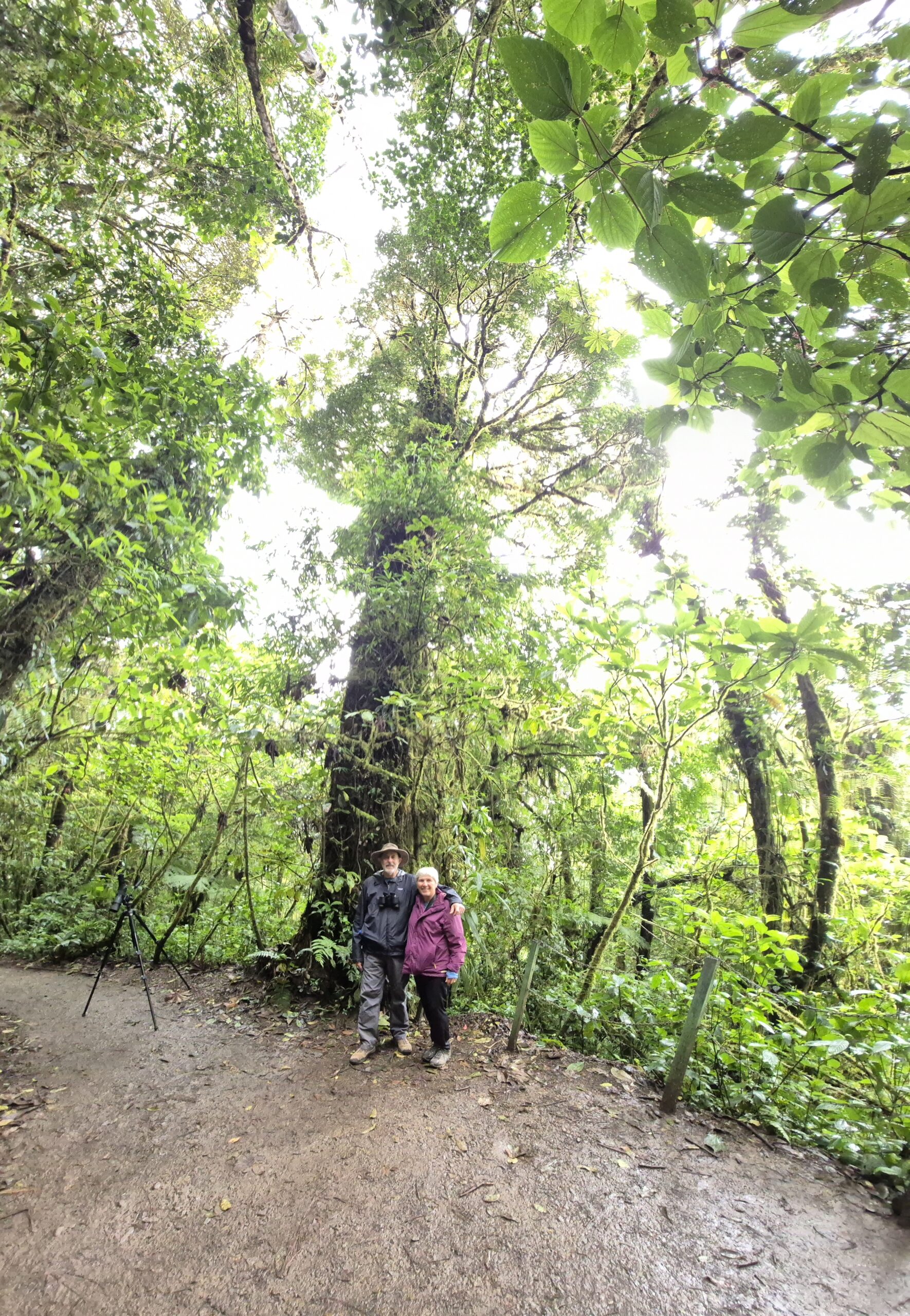
Since our last blog entry, we have traveled to la Fortuna (Arenal), on the east slope of the central mountains, Monteverde, IN the mountains, and Liberia, west of the mountains. I am writing this in Tamarindo, which is on the Pacific coast. The Central Mountain Range in CR divides the country from Caribbean Climate to Pacific Climate. As the winds push the humid, warm air up the mountains, it drops ALL its moisture, so Arenal and ESPECIALLY Monteverde are wet year around.
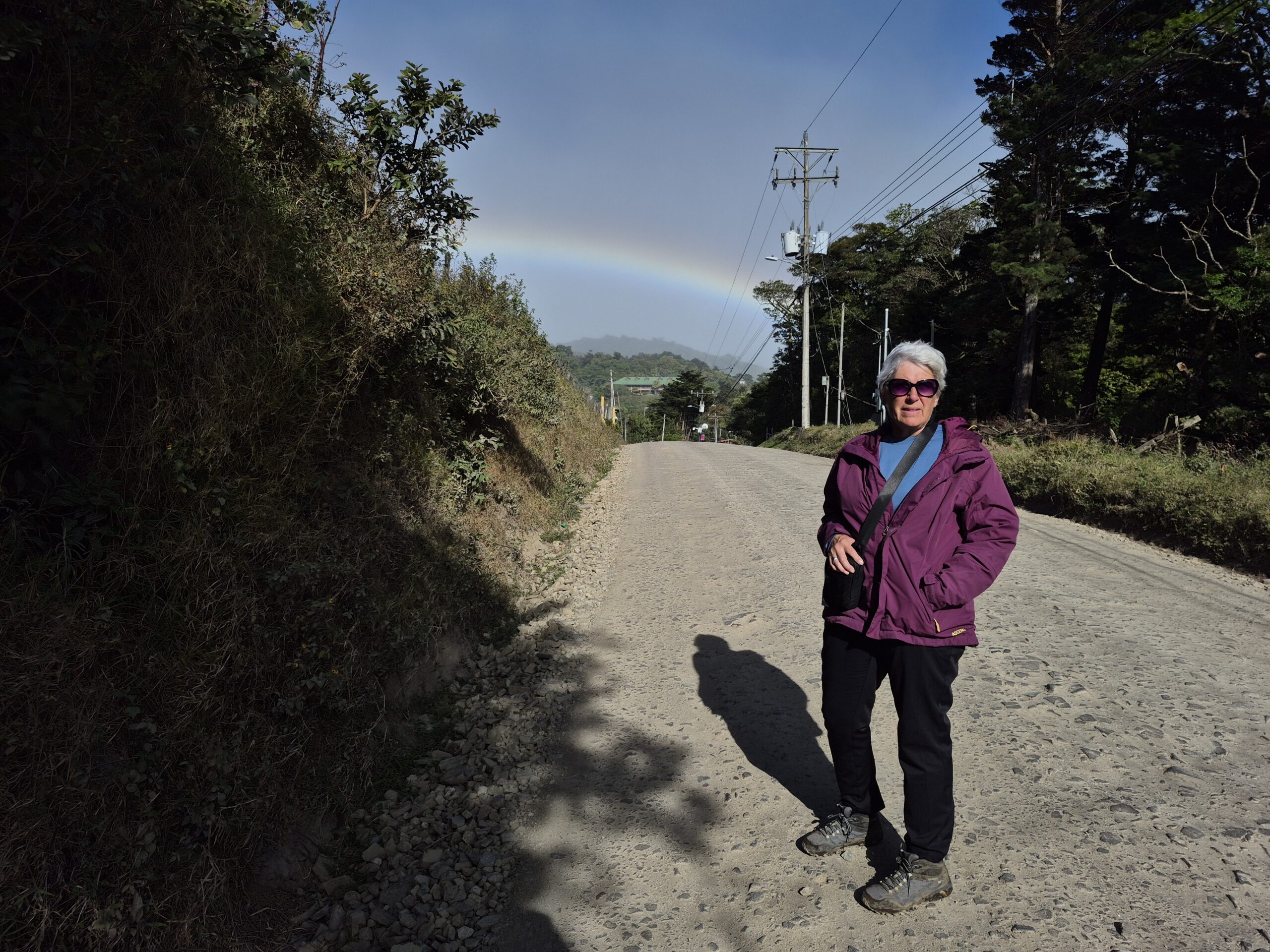
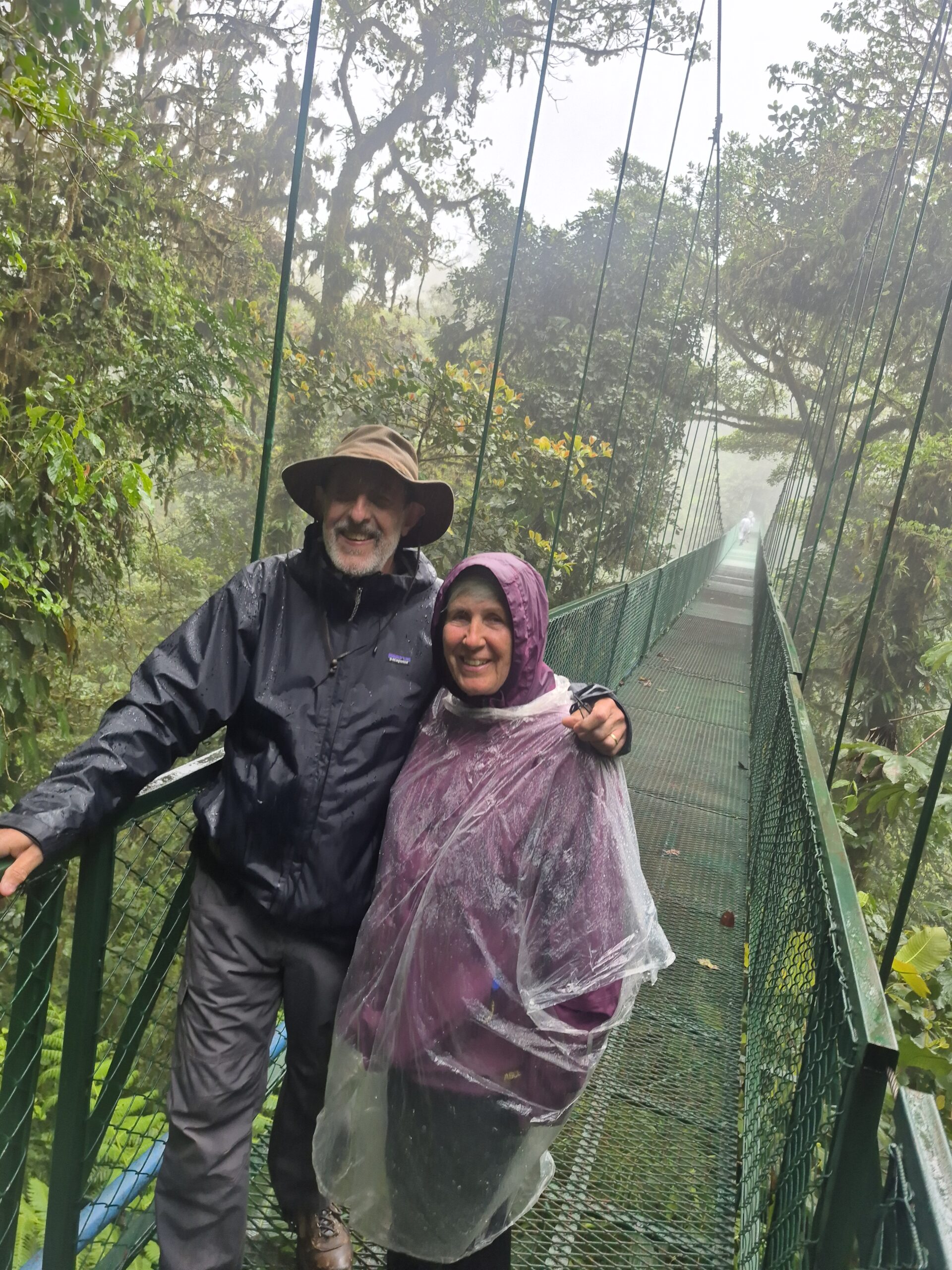
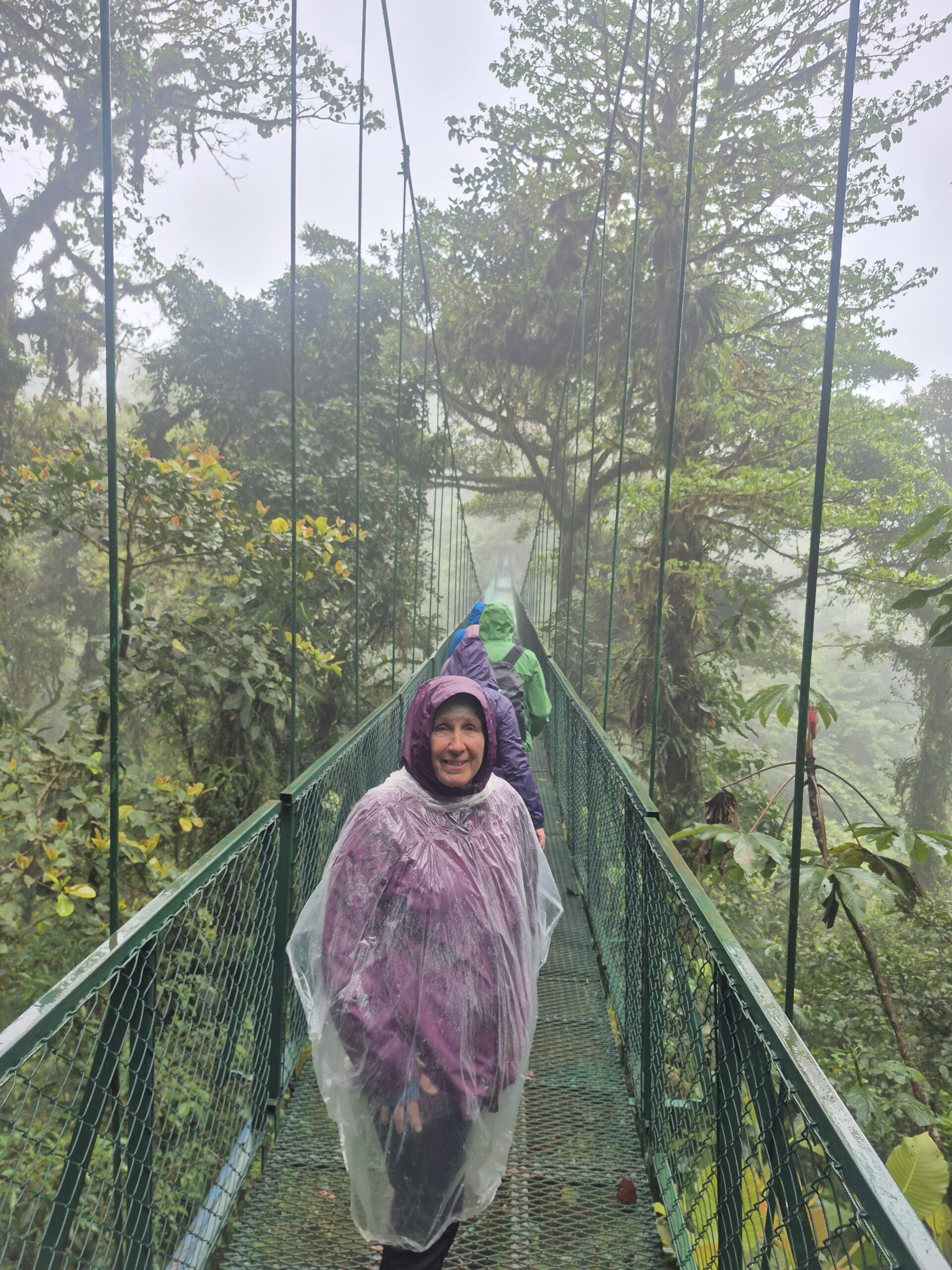
The latter is in what is referred to as the “Cloud Forest” because it is essentially in the middle of the cloud deck created by that rising moisture. When we were there it was at least “misty” or drizzling the whole time…even if it was sunny! Our hikes were ALWAYS wet and muddy, and sometimes also wet from rain, mist.
Once we descended the west side of the mountain to get to Liberia and then the coast, the air became dry, the sky severe clear and our clothes, which had basically been damp since leaving Limon dried in an instant.
And, its not just moisture…temps change a LOT through that range as well. In the mountains, people do not have AirCon. On the Caribbean side, you could not survive without AirCon. But, one thing across all of the climates – heat is NEVER required. Although, we were here during an “epic” cold front, so the temp fell to low 60s at night and low 70s daytime. It was sooo cold that the volcanic hot springs we attended in La Fortuna were actually cool springs…somewhat disappointing, but emphasizing the strangeness of the weather during our visit. For us, it was a decision most days between 2 shirts/layers or just 1. For the Ticos, if they had a down jacket, they were wearing it under their rain poncho!
So, basically, in the space of 50 miles, you have every possible climate from Caribbean rainforest, temperate forest, Cloud Forest to Dry Pacific. Bottom line: Better wear layers…even for a day trip!
The effects of these drastic climate changes create the opportunity to see a very wide range of flora and fauna. Within a few miles, the entire scope of what you will see changes completely. At low elevations, our Guides were always on the lookout for snakes, some of which are poisonous enough to be dangerous. At higher elevations, it’s too cold for snakes, Birds available also vary widely by microclimate. Our guides did mention that Climate Change is drastically affecting the habitats here…as fauna and flora move their location (up or down, east or west) to suit their preferences. In fact, the snakes are moving up as well, so more care needed guiding groups of tasty tourists!
We actually did our transit from east to west by booking tour through a local tour company. They have a “standard” tour package, but were willing to modify it for our pleasure. One of the things I asked for was to skip an afternoon in Arenal featuring 11 Ziplines, 2 “Tarzan Adventures” (apparently swinging an rappelling by ropes), and an underground tunnel expedition. Instead, they substituted an afternoon and evening Nature walk with Naturalist guides. I would say this was the best ask and substitution ever!
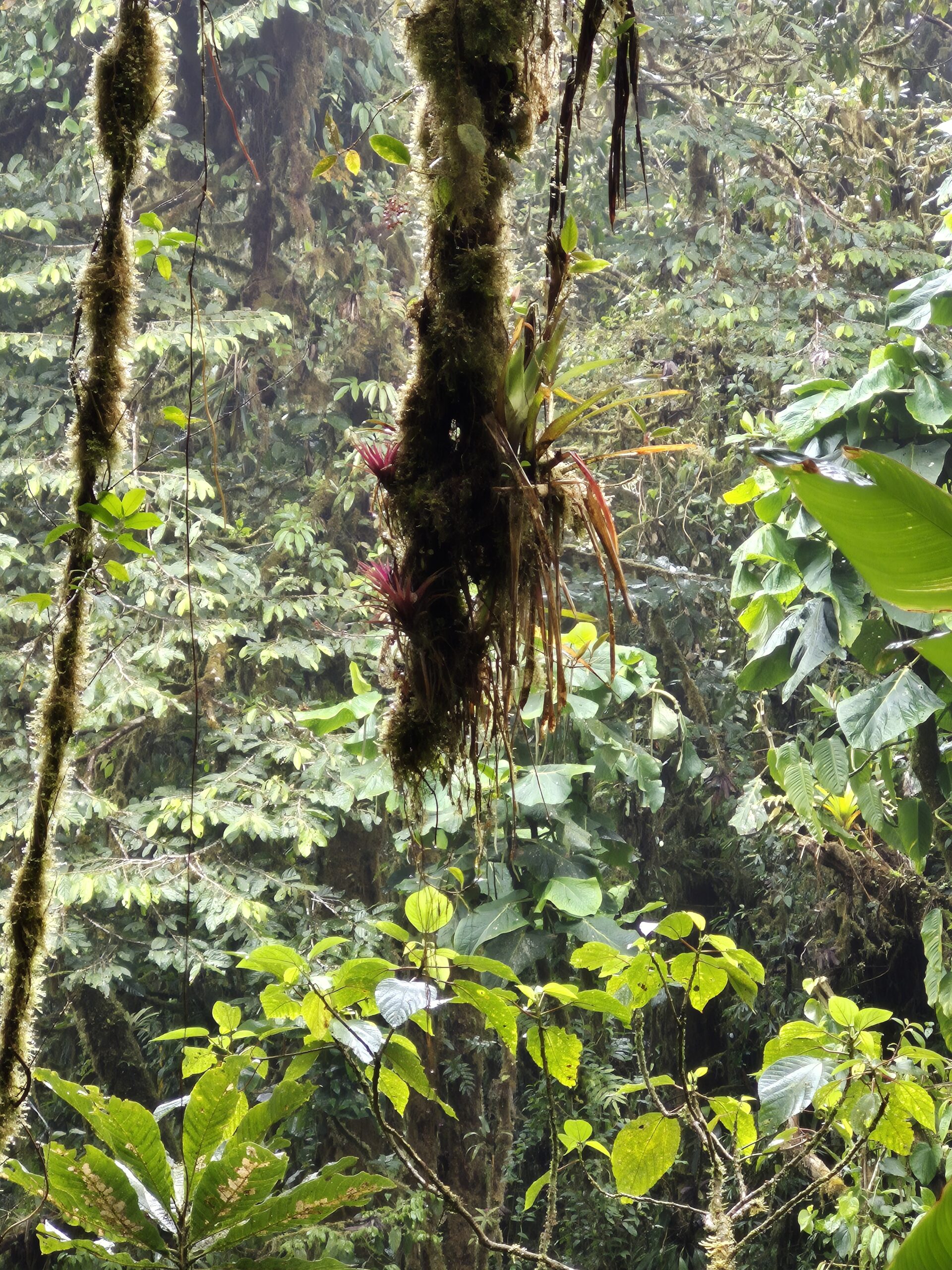
Here’s why we choose to use Guides always: The Rainforest is such a cacophony of sights and sounds in density you cannot imagine until you are in the midst of it. It’s actually hard to describe the sheer volume of flora and fauna that you could see just standing next to a SINGLE TREE, if you take the time to look carefully. Yet, if you want to see some of the iconic plants and animals, you need to pick out those particular grains of sand from the entire beach in front of you. THAT’s the value of a local guide!!
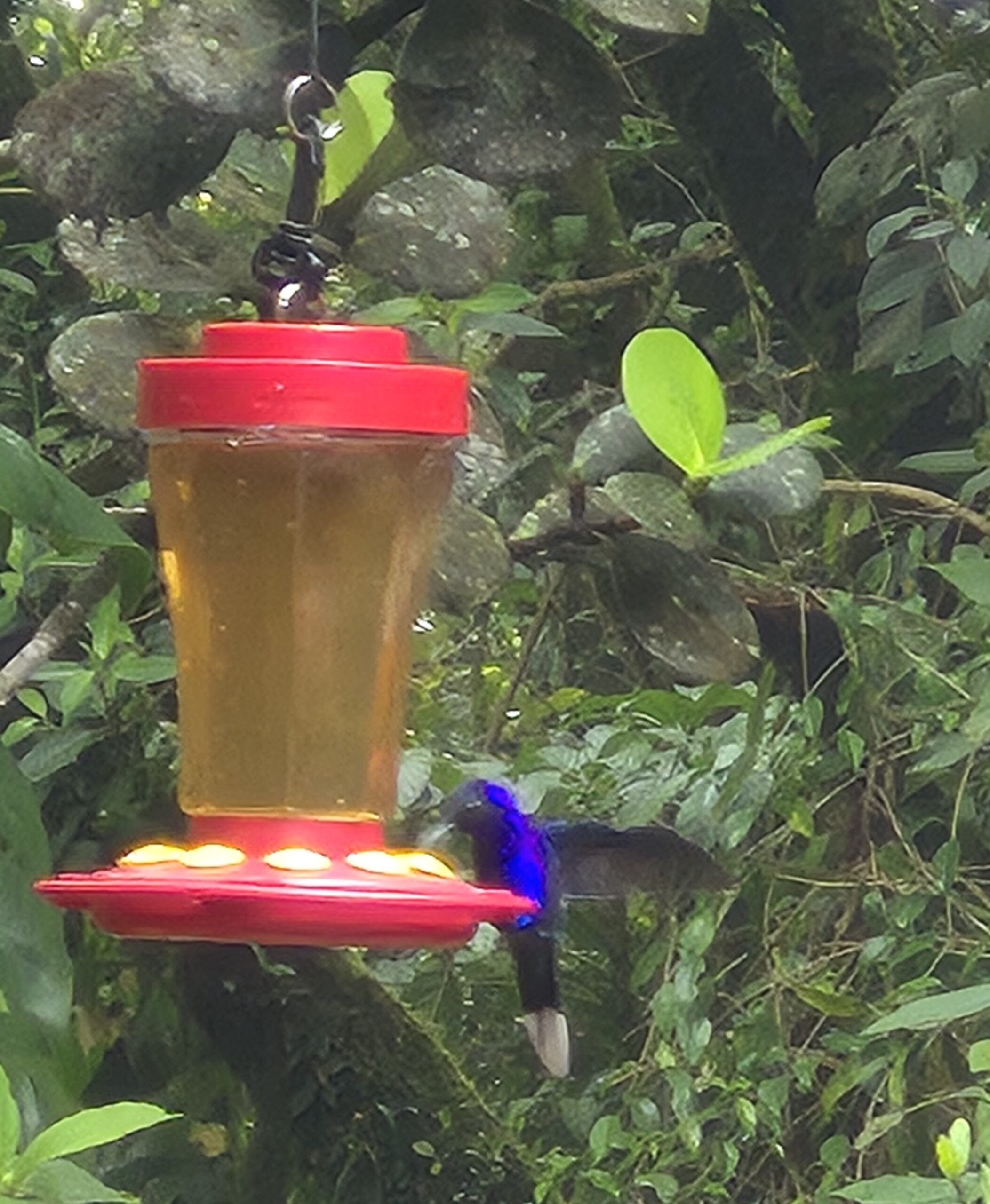
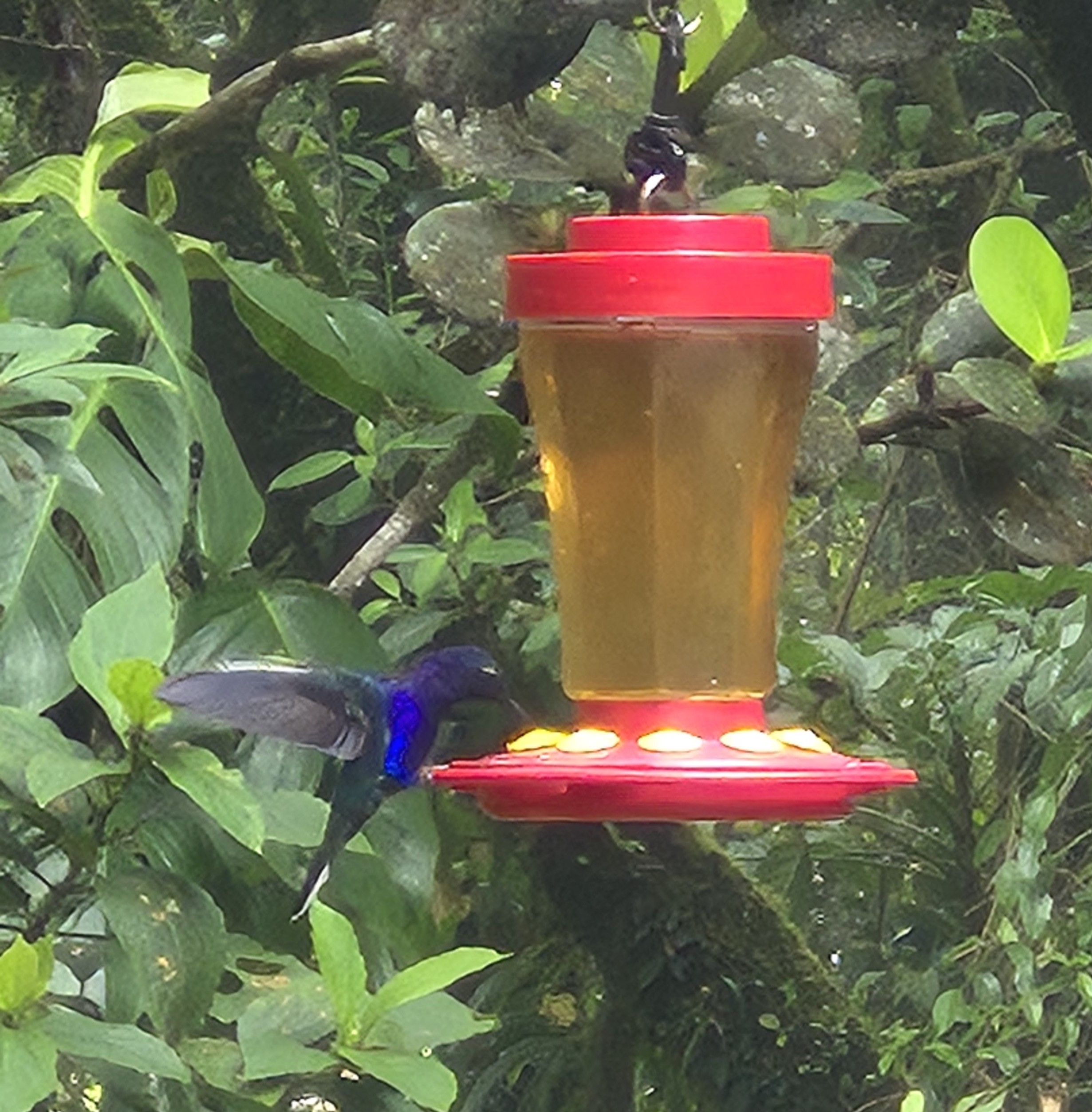
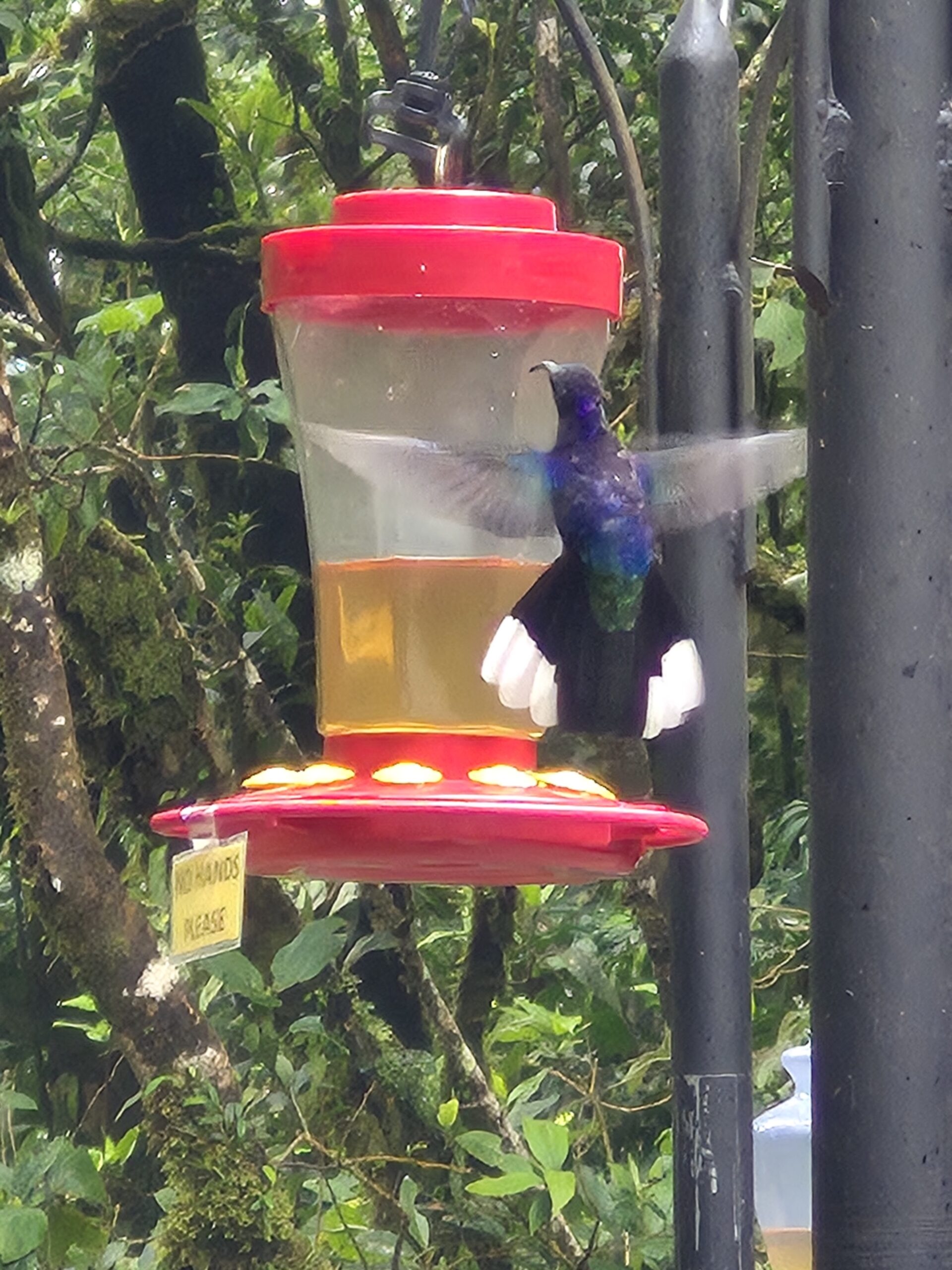
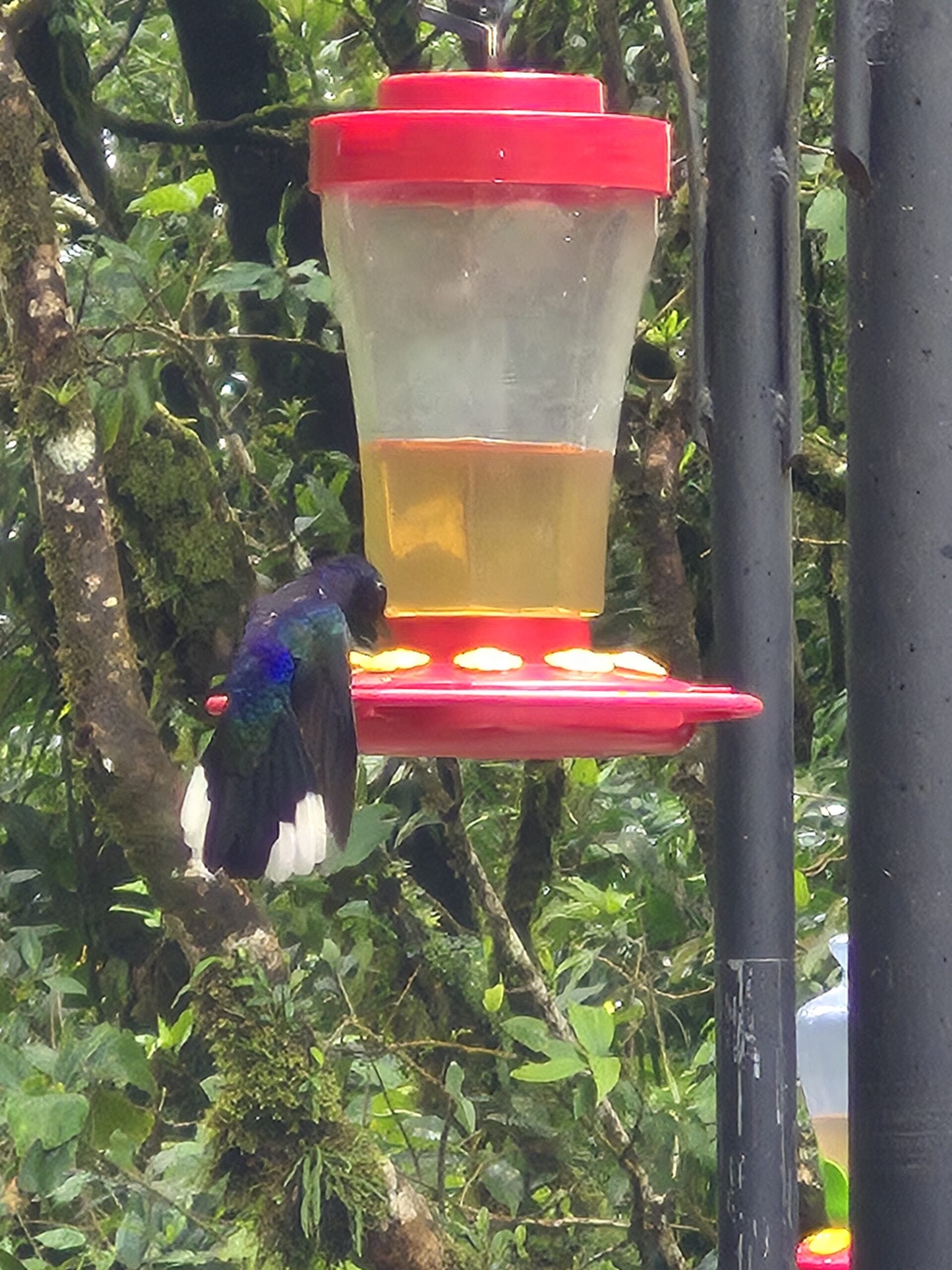
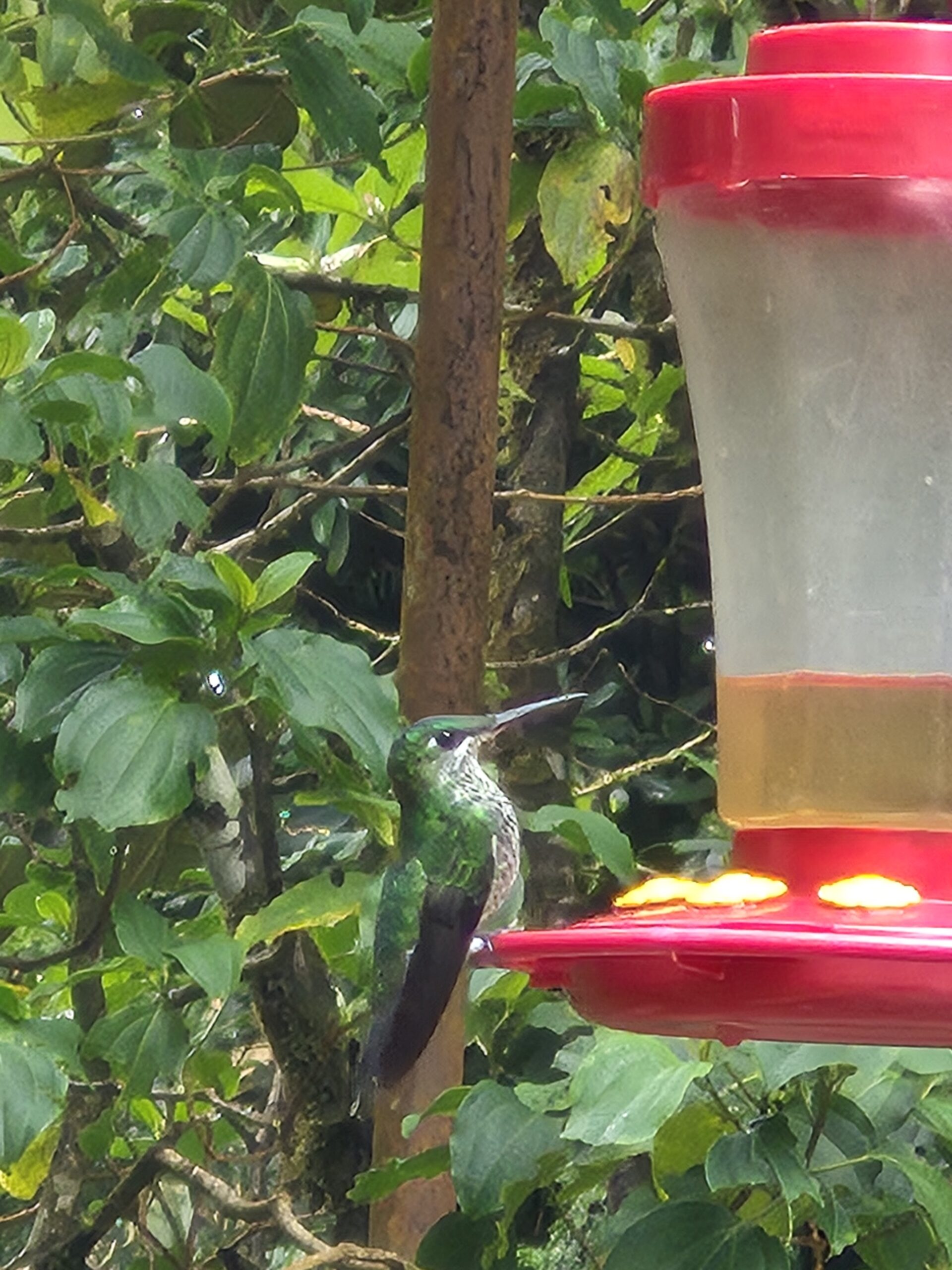
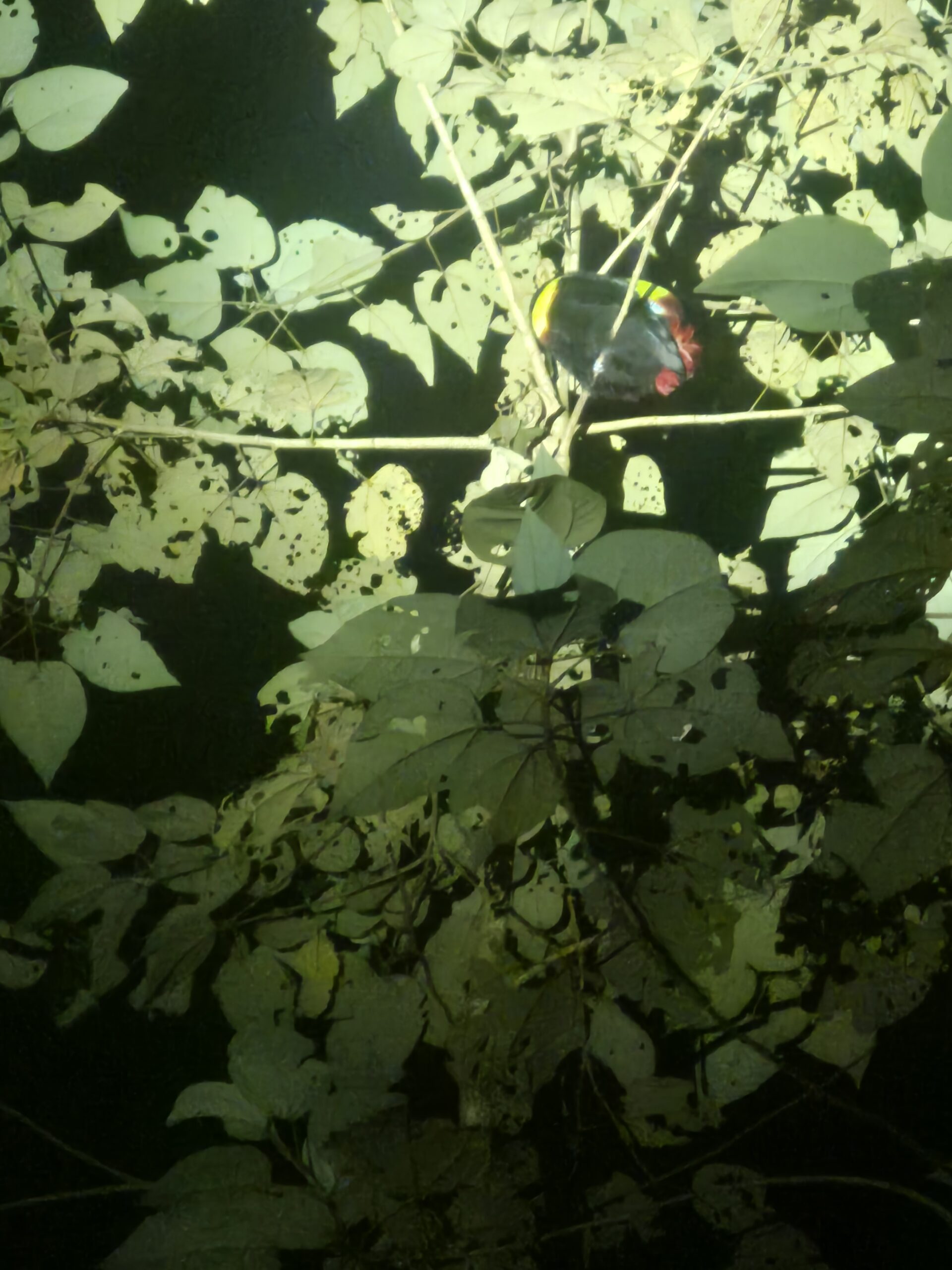
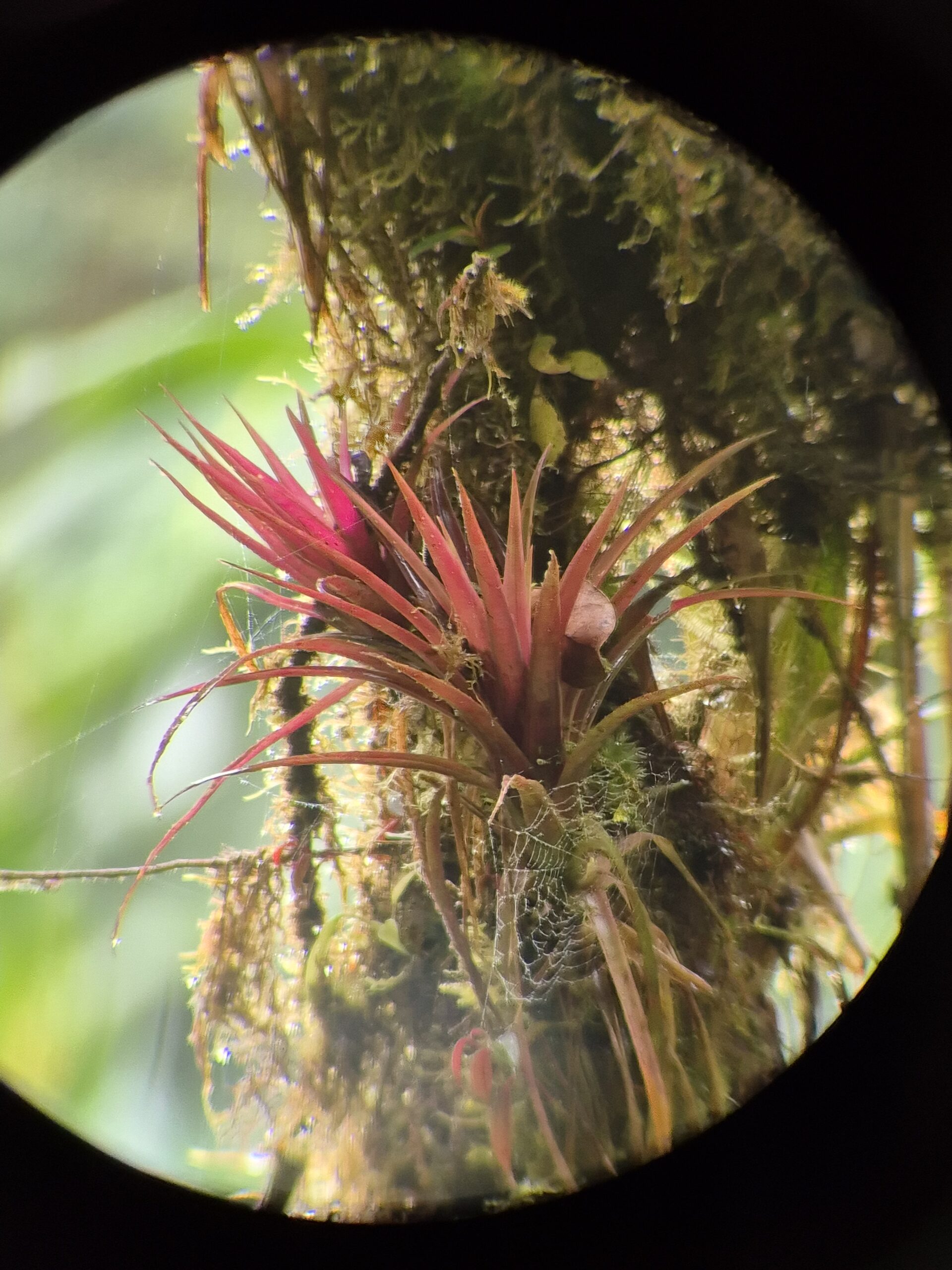
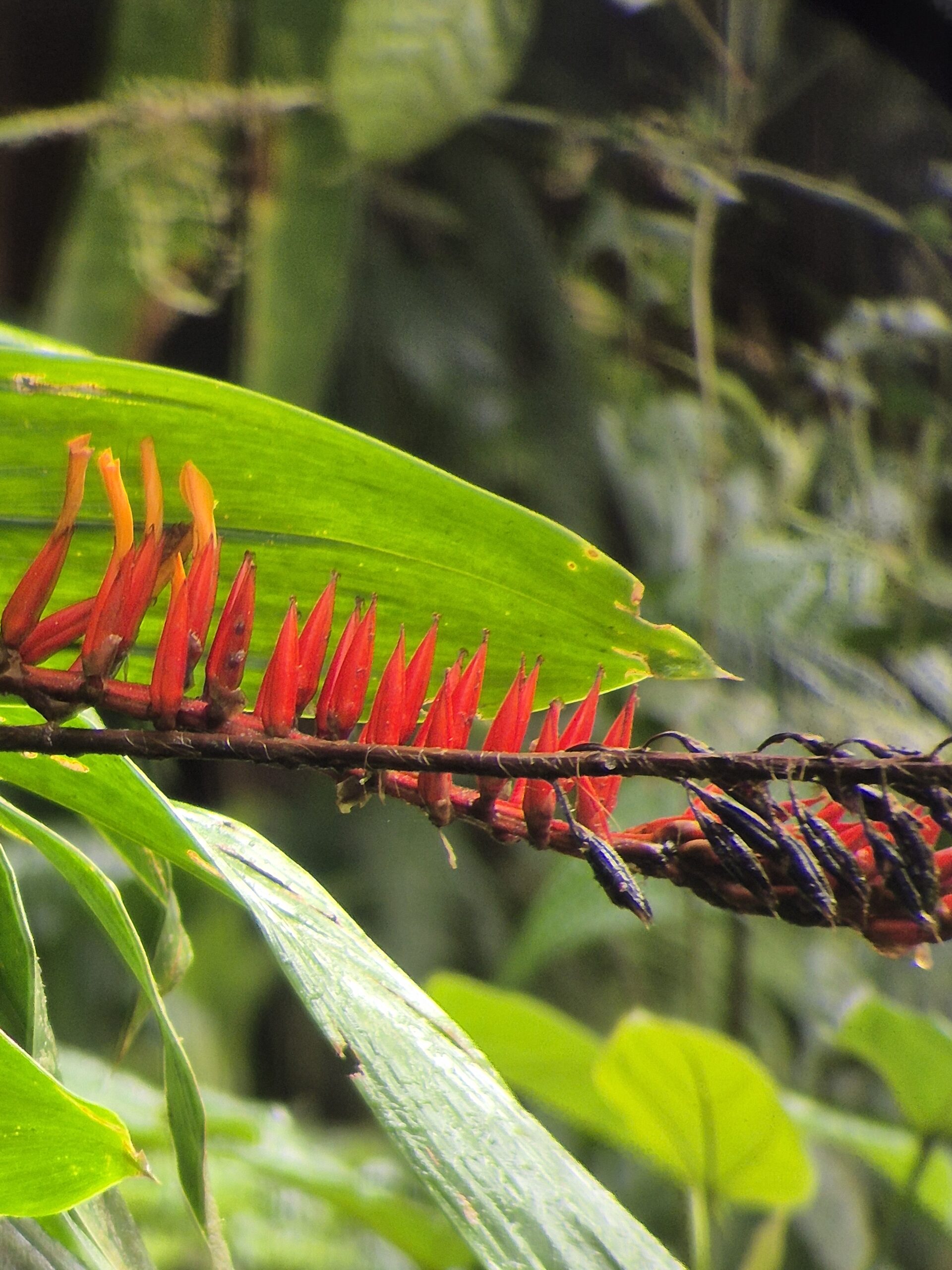
We saw…or more correctly, it was pointed out to us by our guide: Lady Bug balls numbering in the thousands under leaves…invisible unless you turned the leaf over, TINY Orchids the size of a parsley leaf, a ½” scorpion you could ONLY see by illumination of a UV flashlight, a Yellow Viper (yikes!), Hollow Stems hiding ant-defenders that would pour out if you tapped the stem, HummingBirds (MANY species in a rainbow of colors), Birds, Birds, and even a Quetzal (more on that in a minute)!!!
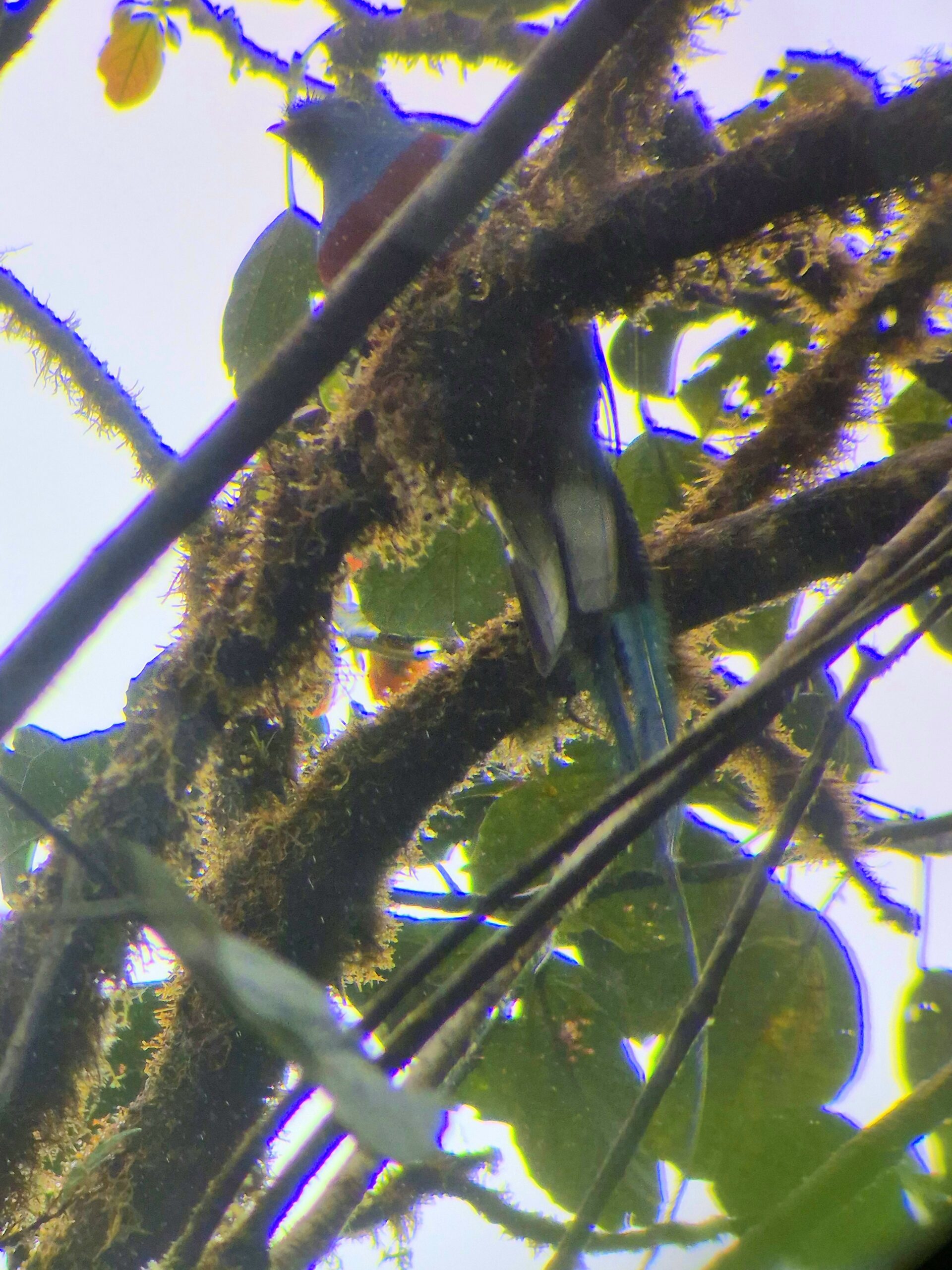
Often, our guide would stop and set up his telescope. He might point it at a bush 10ft away, to show us a butterfly that was not obvious to us. Or a distant tree with a Quetzal on a branch. And, the female Quetzal is a green ball…so rather like spotting a green pineapple at 100 yds in the unbelievably dense, green forest. Sometimes, he would squeeze a leaf and let us smell the peppery, or lemony scent, after which he would describe the medicinal uses. He even showed us a leaf with a soft, velvety underside…he said it was THE BEST toilet paper.
Oh, and we saw all the macrofauna as well: Howler, Spider and Capuchin Monkeys, Sloths with 2 and 3 toes. Iguanas. Coati. Aguti. And Birds. Did I mention Birds? People come to CR to add many many birds to their lifetime lists. We aren’t particularly birders, but twice we saw Quetzals, which, I am told, many have to make multiple trips to CR to finally add to their lists. The Quetzal is also the National Bird of Guatemala, so why people would come here multiple times instead of Guatemala to add it to their list must be more related to the Pura Vida all around!
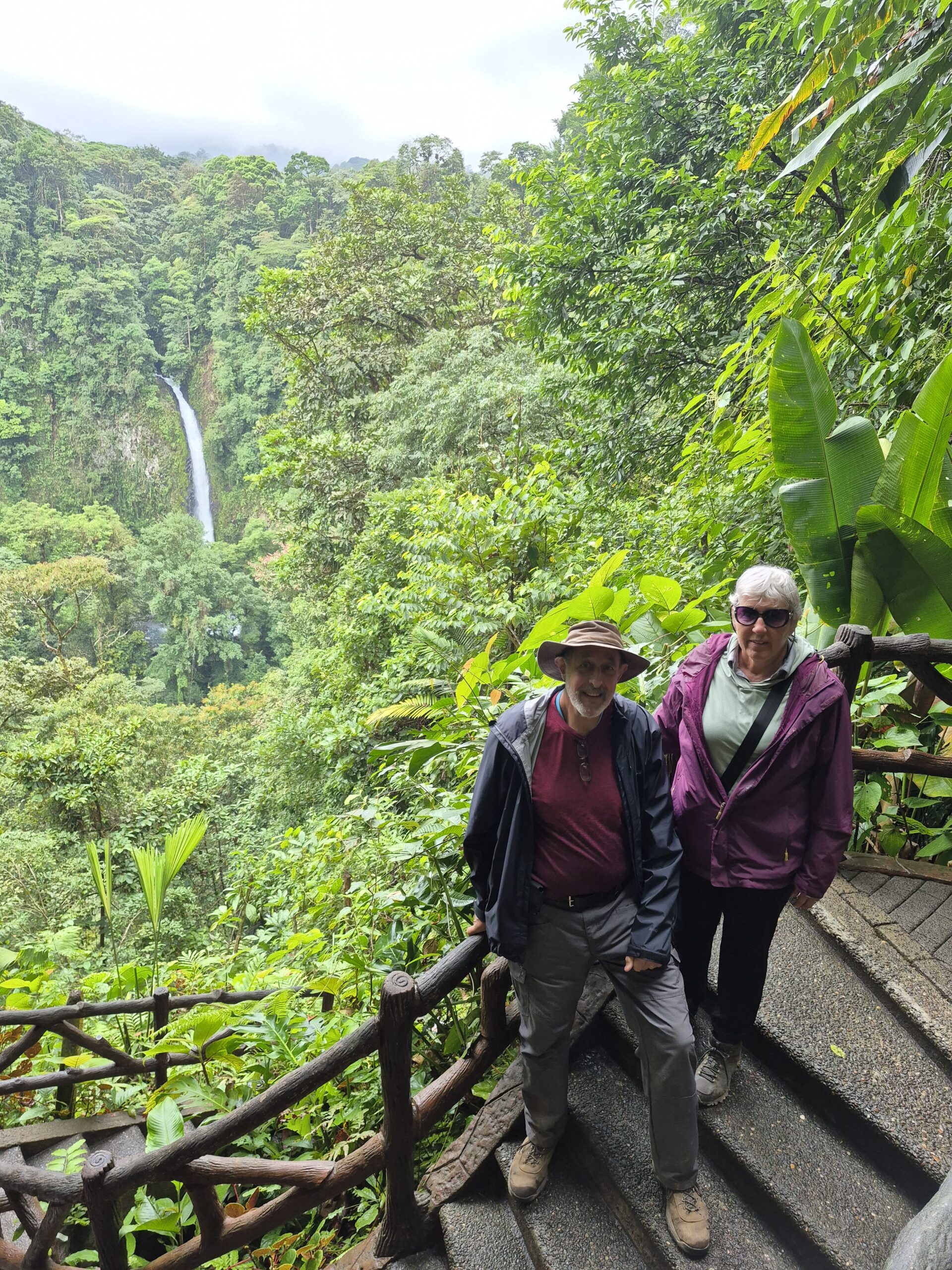
One hike was to the La Fortuna Waterfall. This involved over 1,000 steps to the bottom of a ravine and base of the waterfall. And, of course, 1,000 steps back up!
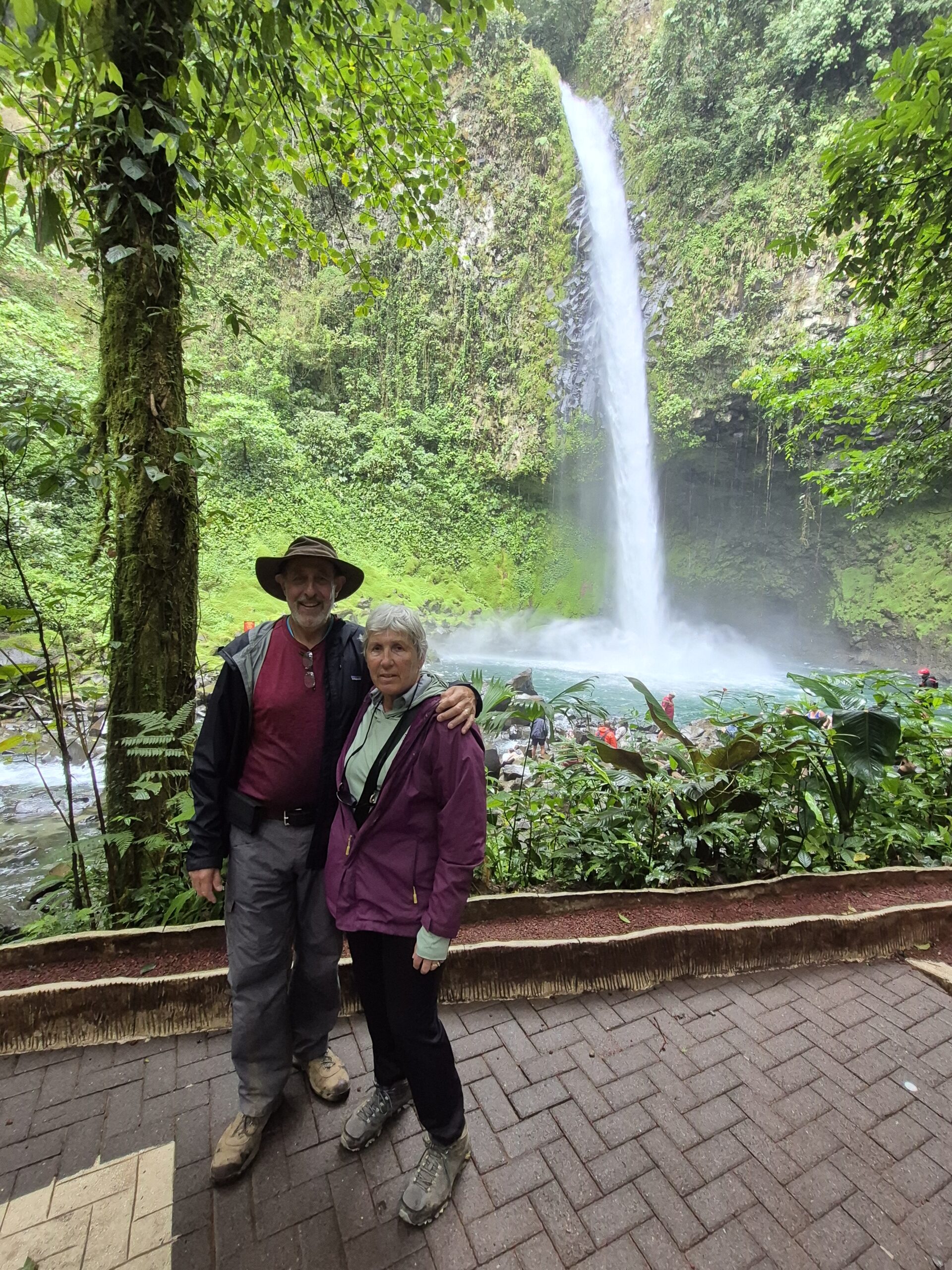
Liz was a little nervous after her (mis)adventure in Limon, but she and we made it down and up just fine!
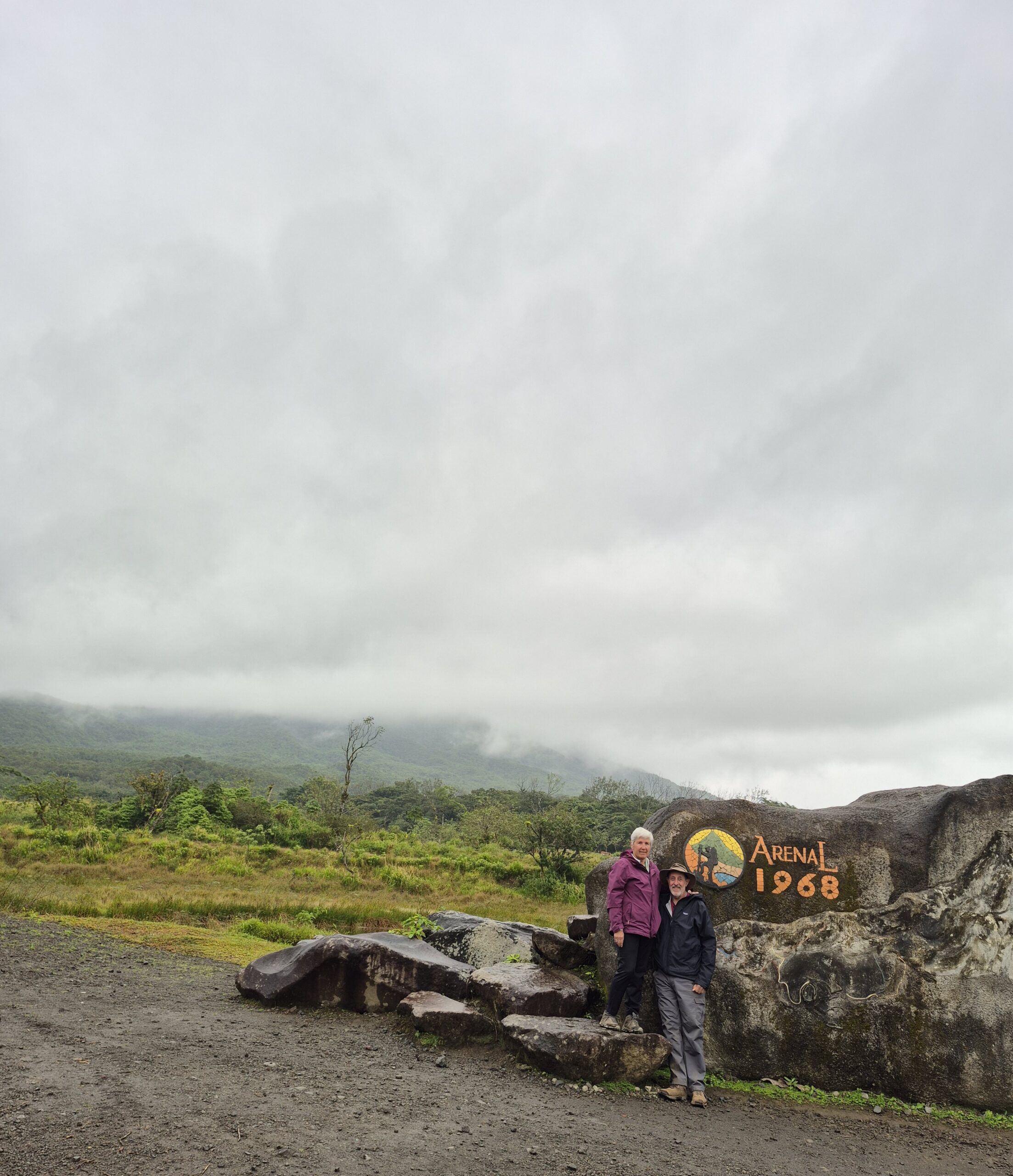
And, we hiked to the terminus of the lava flow in the 1968 eruption of the Arenal Volcano, which buried a couple of small towns. The volcano was active until the early 2000s, but not at the moment. And, Of course, the cloud obscured the mountain itself.!
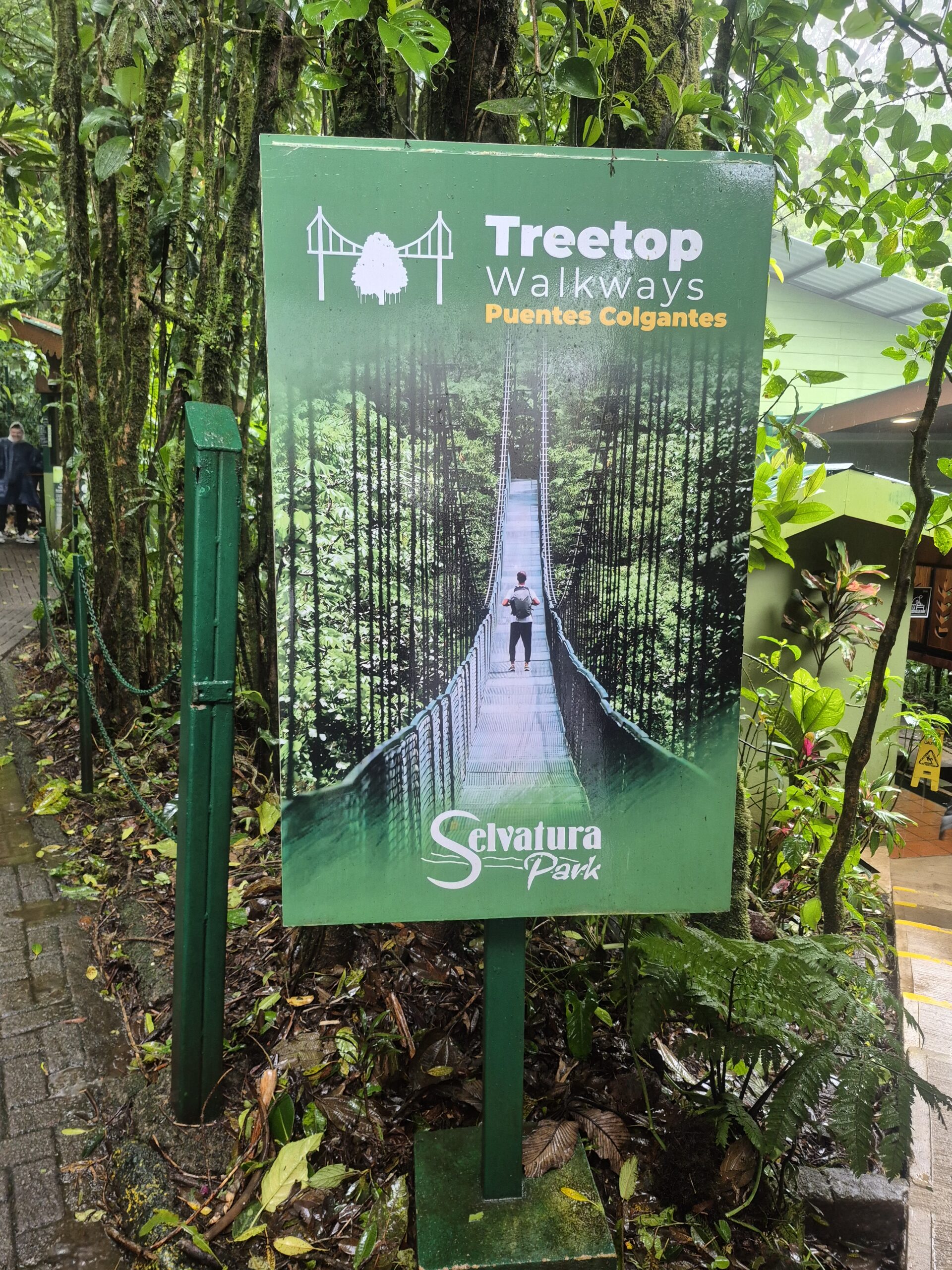
All of that and more were our experiences in Nature walks with guides. Several in the Arenal Mountain region, including one at night, and one in Monteverde. The MV one was especially interesting as it wound through the Cloud Forest and over 10 different Hanging Bridges. These bridges are suspended by cable anywhere from 30 to 100ft over the forest floor, and from 100 to 500 ft long with a see-through, steel mesh floor. It sounds intimidating and acrophobic, but remember the trees are all around and under the bridges, so even though the bridges sway a bit, you really don’t feel all that high. Plus, being at canopy level, you see things that you could never see from the ground.
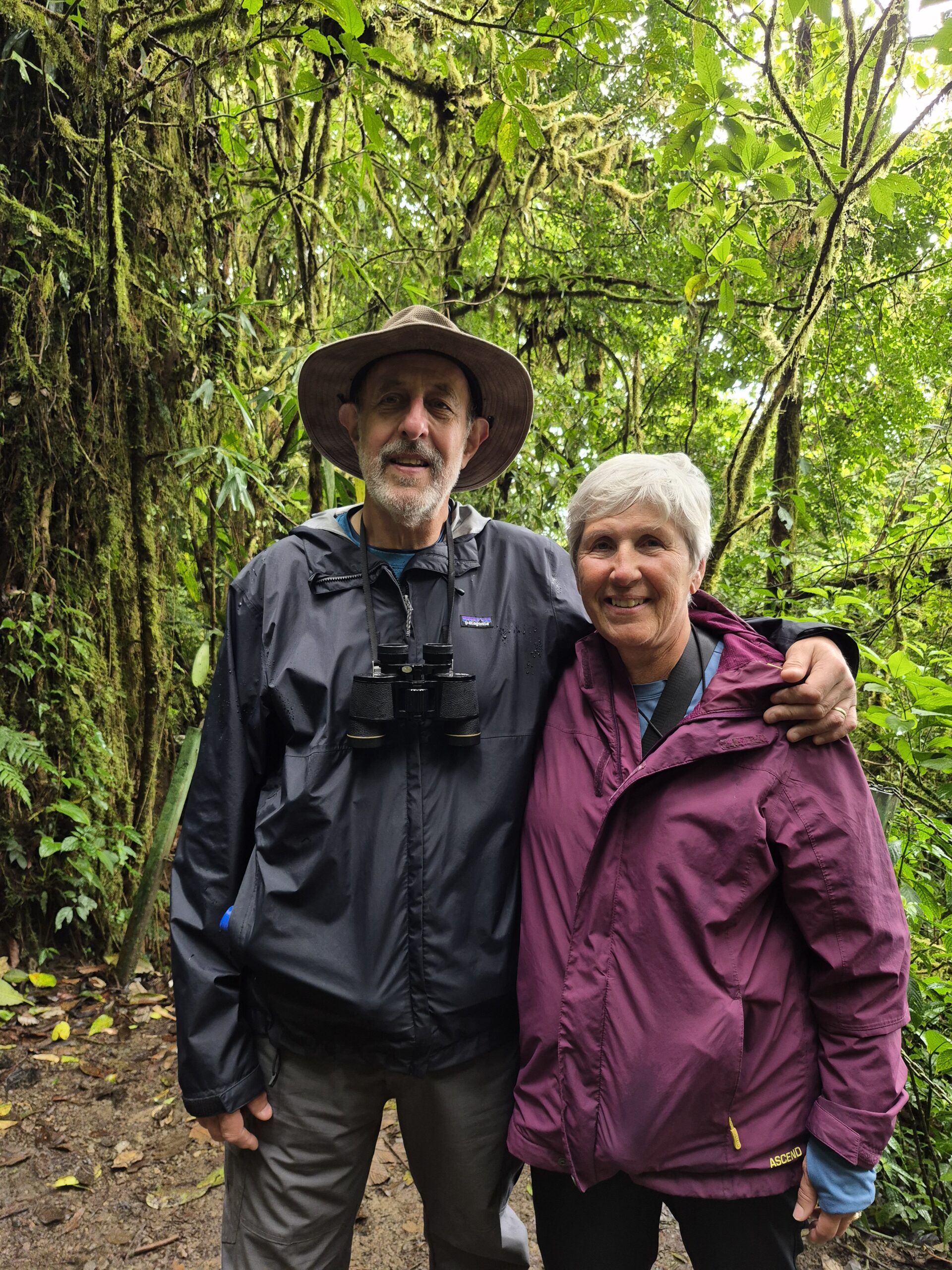
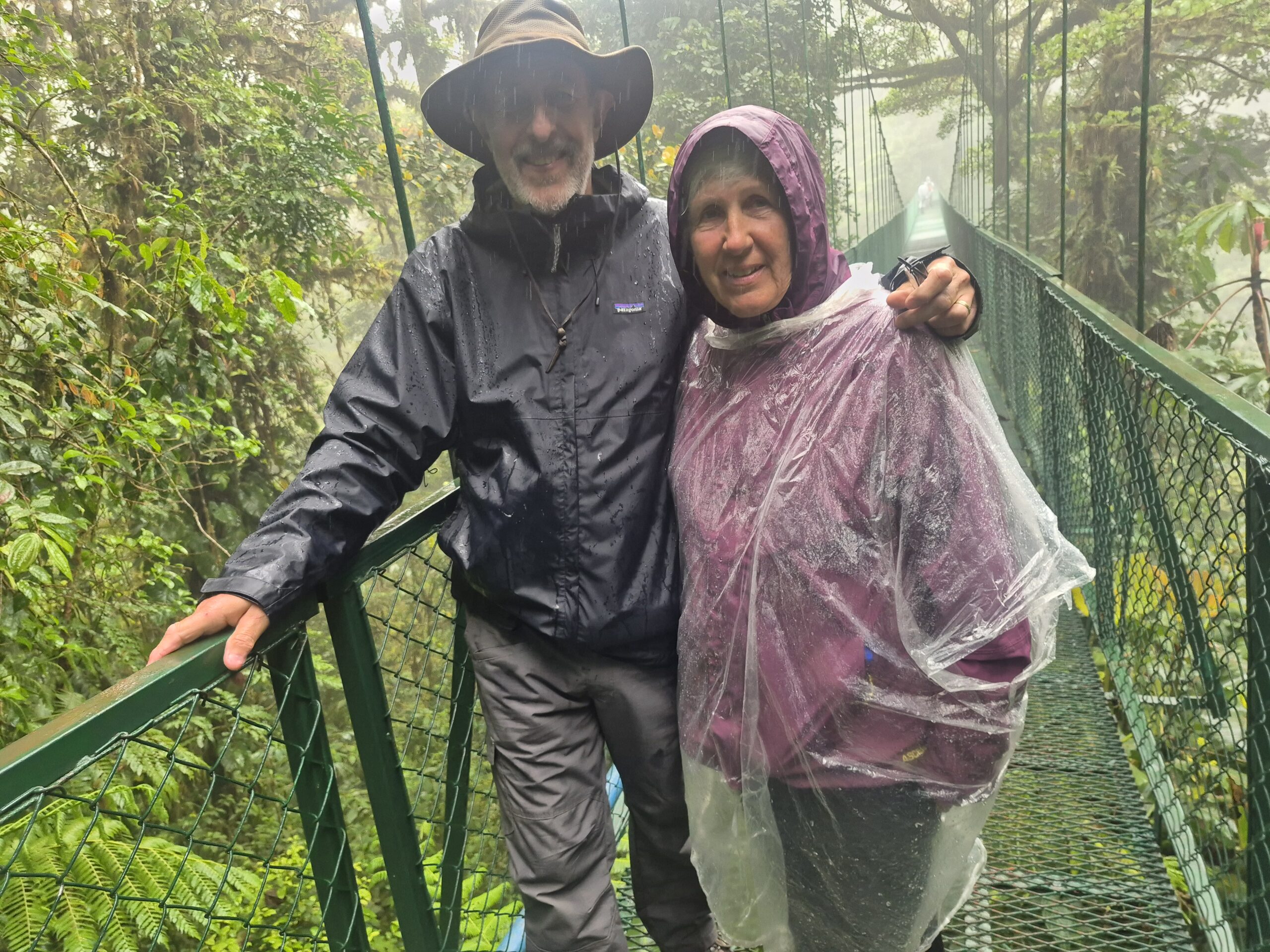
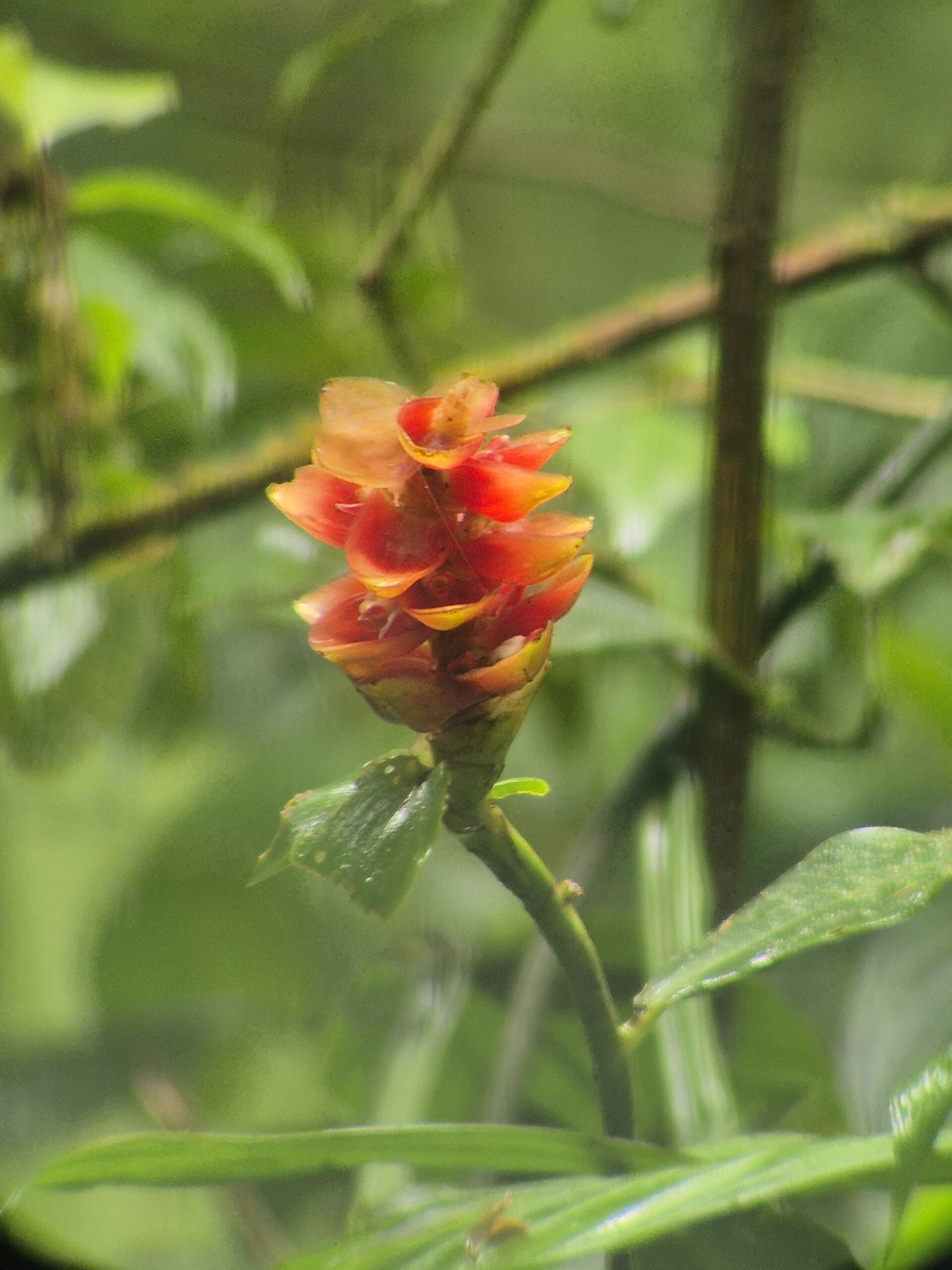
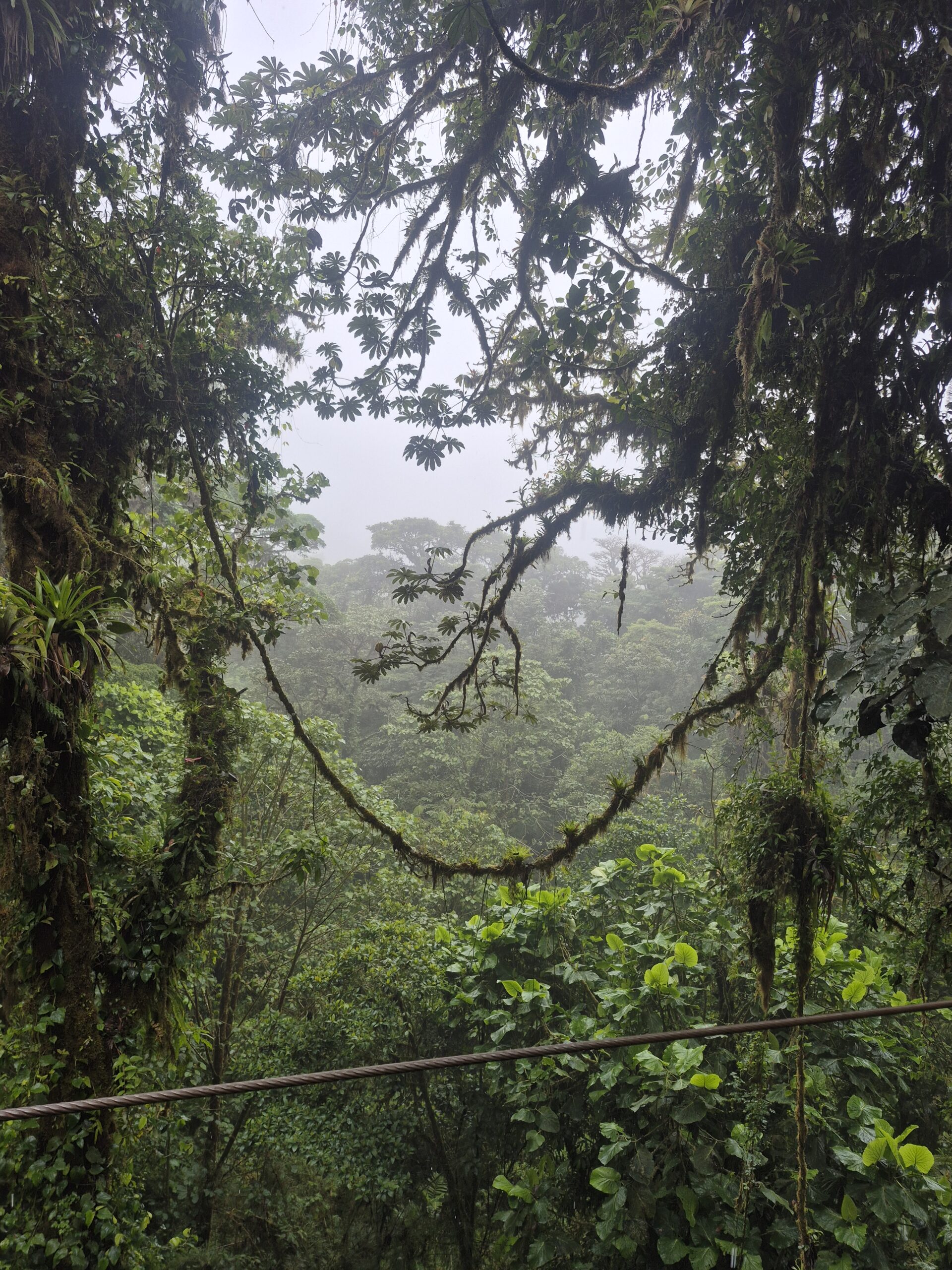
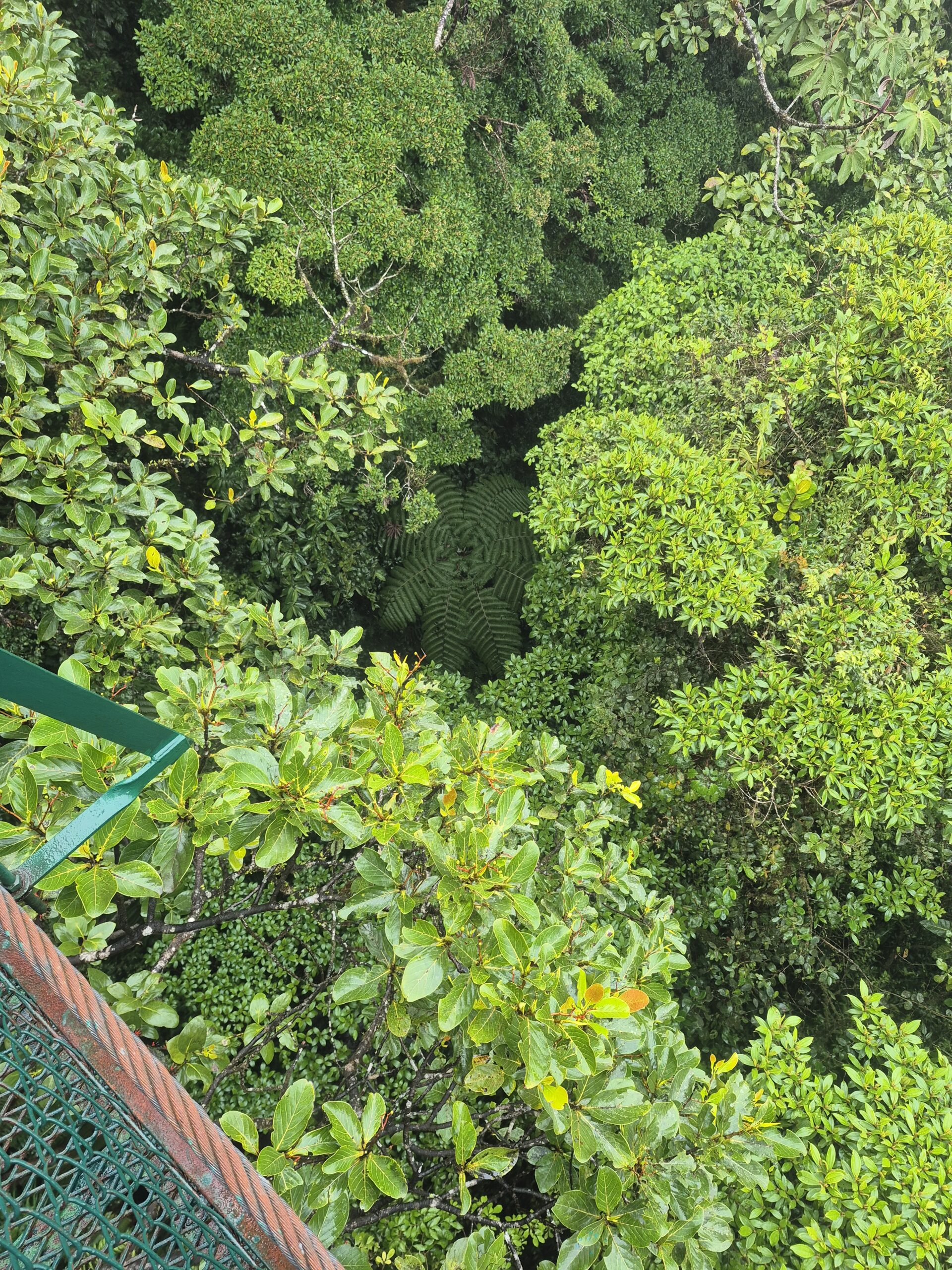
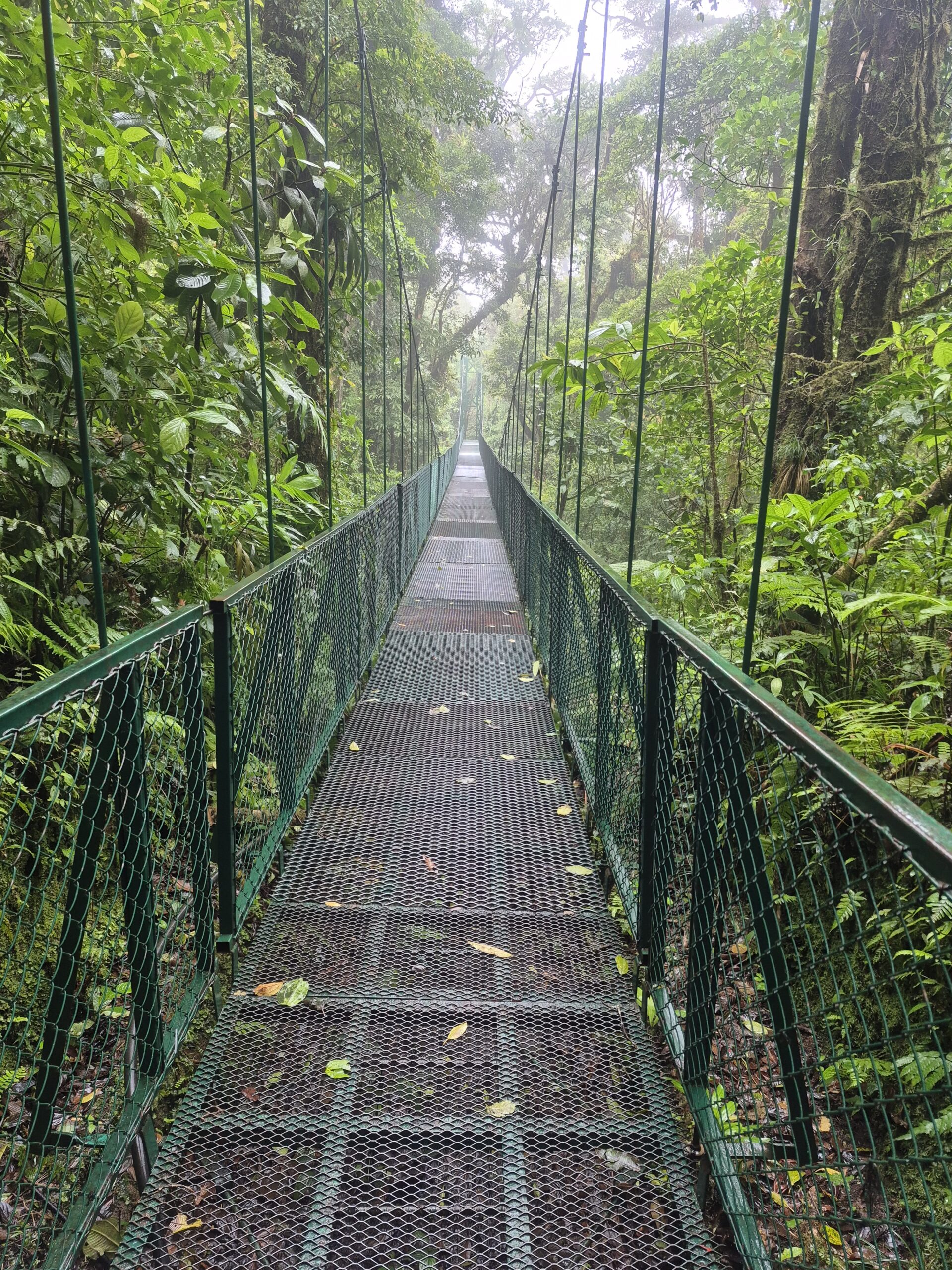
And, here’s why to skip ziplines (unless you are after a Costa Rica Disney experience). There are a LOT of them down here, and on our hikes we occasionally heard the high-pitched whine of a zipper hurtling by above us, so people MUST patronize them. But here is how we see it:
- Take the mist and rain that we endured for 2 hours in our Monteverde hike, making us quite damp. Then add 30 mph forward speed at times. Sound like fun?
- They often do tandem ziplines to add weight, otherwise the wind is so strong (and you are so exposed!) it can stop you mid-line!!!
- There is no way to stop, listen and follow a particular sound to a particular tree, On a zipline, with rain blasting in your face, you would see…and hear…only rain blasting in your face!!
- There is no guide to help. Almost Whatever we saw is because our guide asked us to stop, or made mimic calls. Often, he would set up his telescope and point it at a seemingly random spot, only to reveal a moth, bird, frog or snake. You cannot do any of those things as you fly past, sans guide, whatever might have been there to see.
Lake Arenal is a man-made lake in a valley under the mountain that most recently erupted in 1968 (and continued until the early 2000’s). We walked to the base of that flow, and on a clear day a great vantage point for the mountain. Which, of course, we did not see at all due to low clouds, mist and fog. This is quite common for the Arenal region, as I described above. The lake generates about 7% of Costa Rica’s electric power…hydroelectric is responsible for almost 3/4 of the power here.
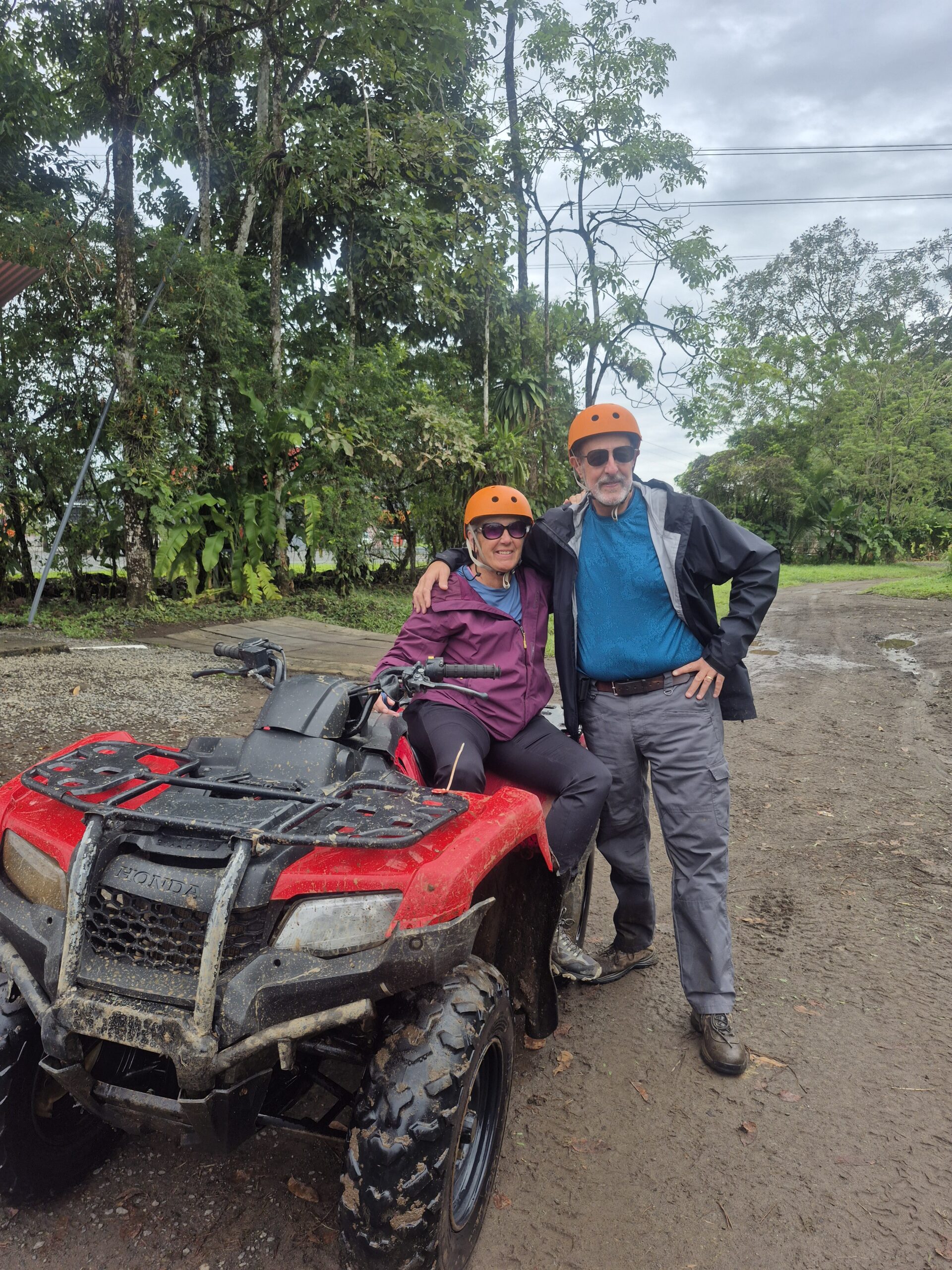
In Arenal, we DID take a day to do “tourist” things. This included an ATV ride and whitewater rafting. Liz decided the former was “ a guy thing,” so she asked to sit out the second hour. Which was fine, cuz we then went out and did even more “guy-ish” things. That included doing donuts in mud-wallows. I even managed to get my ATV stuck in said wallow. But the guide cheerfully worked to extricate me and ended up covered with mud from head to toe for his trouble. I mean, I was muddy, but he was next-level…
The whitewater rafting was a new experience for both of us. When the tour company proposed this, I almost declined, wanting to spend as much time as possible experiencing things uniquely Costa Rican. But, we’d never done this before, and I suspect this is an activity where there is an expiration date based on our age and capability. Many of our friends thought we may have already reached this age, and my sister wanted to make sure our estate documents were up to date. To say Liz was nervous would be quite the understatement. She could have decided to not go, just as she decided to forego the last hour of epic mud tornados (I certainly knew better than to apply any pressure!), but on the bus to the put-in point, there were some tourists from the UK who had at least 10 years on us. They said they had done this many times, which helped Liz decide. By the end of the day, she was admitting that she would even consider doing it again!!
Pablo also explained what to do if ejected from the raft, causing Liz to momentarily reconsider her decision
As for the trip itself, the rapids on the Sarapiqui River, were advertised as “class II and III, which is moderate on a scale peaking at “V.” Our Bus Chaperone was one of the guides, “Pablo,” and he said that, due to much recent rain, they were a “Heavy III,” but “Don’t worry…be happy!” Then he taught us the 5 commands we needed to know as motive power for the trip, including the 2 safety commands. The three non-safety commands: FORWARD (meaning paddle forward), REVERSE and STOP. Next the Safety Commands. “LEAN-IN” and “OH GOD.” The latter, Pablo said, is sometimes expressed “Get Down.” Pablo also explained what to do if ejected from the raft, causing Liz to momentarily reconsider her decision, and introduced us to the safety kayak pilot, and also the “paparazzi” who would sell us pictures at the end. Before launching into the flow, we practiced all of these. During the trip, we executed all of these, but “Oh God” only a couple times.
I did notice, later, that when Pablo broke us all into Groups as raft capacity was max-6, Pablo somehow ended up with the gorgeous Swedish and German Girls travelling in their Gap Year, some of whom were rafting in Bikinis. One group of older folks from the UK ended up in a raft together, and in retrospect, I think even Pablo may have wished he hadn’t arranged things this way. The UK group got in a little trouble because no matter how much FORWARD was commanded, they had fairly weak paddling capability. But it all worked out in the end…at least all the rafts and groups made it thru; I actually don’t know if Pablo got any dates, but he WAS pretty charming.
Our time in the rainforest came to an end, and we moved onwards towards the west coast. Exactly where and for how long, yet to be determined. This trip has been very ad hoc, as is our travel around the US. So far, the most fun has been unplanned, so we endeavor to be as unplanned as possible.

Great account, Dan! Hope you’re keeping all your guide references.
Love hearing your adventures but especially when you share about the beauty and adventures in God’s creation! Let’s you experience the love God has for everyone! No man can create such beauty! We had the pleasure of meeting you and Liz at, I believe you stated it was your first rally in Berlin, Ohio~ Amish Country.